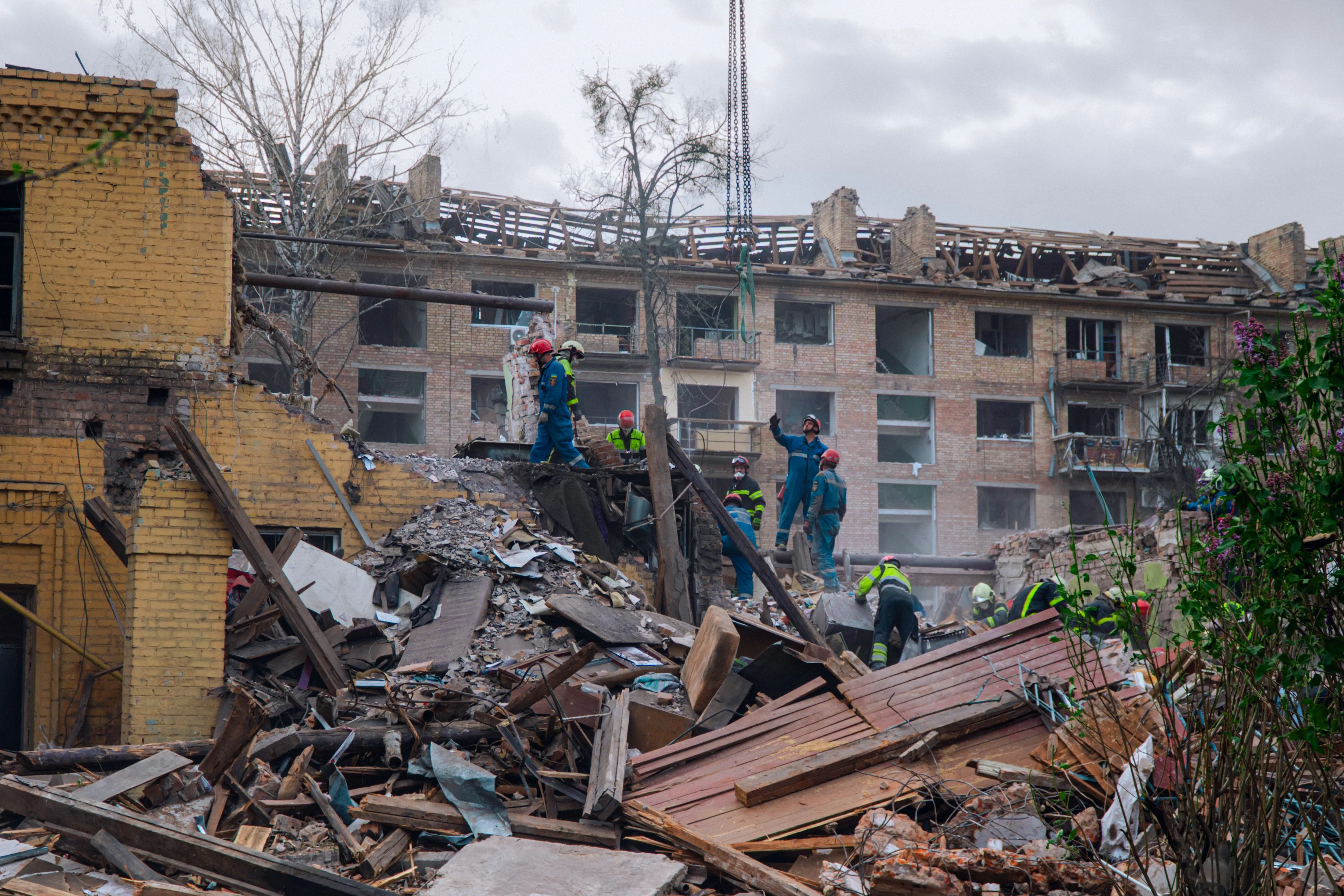
Russian missile and drone strikes hit Ukraine on Saturday, injuring at least nine people and damaging critical infrastructure just days before Russian, Ukrainian, and American negotiators are scheduled to meet for renewed peace talks.
The attacks struck Kyiv and several other regions, damaging residential buildings, power facilities, and a major bridge connecting parts of the Ukrainian capital.
According to Reuters, the strikes placed additional pressure on Ukraine's electricity and heating systems as temperatures continued to fall ahead of winter.
Ukrainian President Volodymyr Zelenskyy accused Moscow of intensifying its attacks to pressure Ukraine before negotiations.
Russia acknowledged targeting infrastructure but maintained that its operations were directed at facilities supporting Ukraine's military.
The timing raises an important question: Can meaningful peace negotiations move forward while both countries continue military operations, and what happens to civilians caught between the fighting and diplomacy?
What Happened in Kyiv?
Russian forces launched a series of missile and drone attacks overnight Friday into Saturday, targeting Kyiv and other parts of Ukraine.
According to Associated Press reporting, at least nine people were injured across the country.
The strikes damaged homes, commercial properties, and infrastructure essential to daily life.
Kyiv's Northern Bridge, a major crossing connecting residential areas on opposite sides of the Dnipro River, was also damaged.
Authorities temporarily closed the bridge while crews assessed the destruction and began repairs.
Kyiv Mayor Vitali Klitschko said work was underway to restore the crossing and stabilize water supplies.
But the broader damage to the city's energy infrastructure presented a more difficult challenge.
Residents faced disruptions to electricity, heating, and water services, adding to existing pressure on Ukraine's power grid.
The damage comes as winter approaches, when reliable electricity and heating become increasingly important for millions of people.
Ukraine Says Russia Launched 36 Missiles and 172 Drones
President Zelenskyy said Russia launched 36 missiles and 172 drones during the attacks.
According to the Ukrainian president, only four of the missiles were intercepted, highlighting shortages of air-defense equipment.
He said the strikes affected Kyiv and 12 additional regions.
These figures represent Ukraine's official assessment and have not all been independently verified.
Zelenskyy also said preliminary findings suggested that North Korean-manufactured KN-23 ballistic missiles were used against at least one energy facility.
If confirmed, their use would provide another example of the international supply networks supporting Russia's military operations.
However, the identification of the weapons remains based on preliminary Ukrainian assessments.
The president called for additional air-defense assistance from Ukraine's international partners.
The issue is particularly urgent because missile-defense systems require specialized interceptors that can be expensive, difficult to manufacture, and limited in supply.
Even when defensive systems are operating, a large number of simultaneous attacks can strain their capacity.
Russia Says It Targeted Military-Related Infrastructure
Russia's Ministry of Defense acknowledged carrying out strikes against targets in and around Kyiv.
According to Reuters, Moscow said its forces targeted facilities connected to Ukraine's military-industrial sector, along with energy and transportation infrastructure.
Russian officials said the Northern Bridge was used to transport military equipment and personnel.
The ministry also claimed to have targeted an industrial facility producing Ukrainian cruise missiles, along with electrical substations and other industrial sites.
These statements are Russia's explanation of its military objectives, not independent confirmation that every targeted location was a lawful military objective.
The distinction matters.
Infrastructure such as bridges and electricity networks can serve both civilian and military purposes.
Under international humanitarian law, the legality of an attack depends on factors including whether a target qualifies as a military objective and whether expected civilian harm would be excessive in relation to the anticipated concrete and direct military advantage.
An infrastructure facility does not automatically lose its civilian protections simply because a military claims it has strategic importance.
Likewise, damage to civilian infrastructure does not, by itself, establish that an attack violated international law.
A proper assessment requires evidence about the target, the anticipated military advantage, the expected civilian consequences, and the precautions taken.
Ukraine's Power Grid Faces Another Difficult Winter
The attacks struck infrastructure that supplies electricity to Kyiv and other regions.
Ukraine's Energy Ministry said facilities involved in transmitting electricity from nuclear power plants were damaged.
The resulting disruptions affected multiple regions, including Kyiv, Zhytomyr, Kharkiv, Donetsk, and Dnipropetrovsk.
Some areas were already experiencing scheduled power cuts intended to manage demand and protect the electricity system.
Saturday's attacks created additional disruptions beyond those planned outages.
The consequences extend beyond temporarily losing electricity.
Power failures can interrupt heating systems, water pumps, telecommunications, public transportation, and medical services.
For households, the impact can be especially serious during freezing temperatures.
For hospitals and emergency services, maintaining reliable backup power becomes essential.
The attacks also raise longer-term concerns about how quickly Ukraine can repair damaged infrastructure while the threat of additional strikes continues.
Peace Talks Are Scheduled for November 10
Despite the ongoing attacks, diplomatic negotiations are expected to resume next week.
Representatives from Russia, Ukraine, and the United States are scheduled to meet in Abu Dhabi, United Arab Emirates, on Tuesday, November 10.
The discussions are intended to explore possible ways to end the war, which began with Russia's full-scale invasion of Ukraine in February 2022.
According to Reuters, Russia plans to send senior diplomatic and military officials to the negotiations.
The Russian delegation will include presidential aide Vladimir Medinsky, Deputy Foreign Minister Sergei Ryabkov, and military intelligence chief Igor Kostyukov.
The meeting would be the latest round of U.S.-mediated negotiations after earlier discussions failed to produce a lasting ceasefire.
Major disagreements remain over territory, security guarantees, and the conditions under which fighting might stop.
The participation of senior officials establishes that diplomatic engagement is continuing.
It does not establish that either side is prepared to accept a particular peace agreement.
Why Are Attacks Continuing Before Negotiations?
The timing of Saturday's strikes has prompted questions about whether military pressure is being used to influence the upcoming talks.
Zelenskyy accused Russia of escalating attacks ahead of negotiations.
Moscow, meanwhile, describes its strikes as military operations against infrastructure supporting Ukraine's armed forces.
Those explanations reflect the positions of the governments involved.
It is possible for military operations and diplomatic negotiations to proceed simultaneously.
Governments involved in armed conflicts may continue fighting while negotiating because a ceasefire has not been agreed upon, because they believe military pressure could affect negotiations, or because their military objectives remain unchanged.
But determining the specific intentions behind an individual attack requires evidence beyond its timing.
The proximity of Saturday's strikes to the Abu Dhabi meeting is significant.
It is not, on its own, proof that the attacks were ordered specifically to influence the negotiations.
A Separate Attack Leaves Dozens Dead in Southern Ukraine
Saturday's strikes came as rescue workers continued searching for victims of an earlier attack in southern Ukraine.
In the village of Komyshuvakha, in the Zaporizhzhia region, Russian guided bombs struck a former school and a nearby shelter where residents had gathered for humanitarian assistance, according to Ukrainian emergency officials.
By Saturday morning, the reported death toll had reached 55, with dozens of people still missing.
The Associated Press reported that rescue teams were continuing to search the rubble.
The incident illustrates the severe humanitarian consequences of the conflict beyond the major cities that often dominate international coverage.
It also highlights the risks facing civilians in communities close to the front lines, where access to emergency services and humanitarian supplies may already be limited.
The reported death toll may change as recovery operations continue.
What Happens Next?
The immediate priority for Ukrainian authorities is restoring damaged infrastructure and assisting residents affected by the attacks.
Engineers and emergency workers are assessing damage to electricity networks, transportation routes, and residential buildings.
At the same time, diplomats are preparing for the November 10 negotiations in Abu Dhabi.
Several questions remain unanswered.
Will Russia and Ukraine agree to any reduction in military operations during the talks?
Can the United States help bridge disagreements over territory and security arrangements?
Will additional air-defense assistance arrive before winter conditions become more severe?
And can Ukraine repair critical infrastructure quickly enough to prevent prolonged disruptions if attacks continue?
The upcoming negotiations provide an opportunity for renewed diplomatic engagement, but there is no confirmed agreement to stop the fighting.
For civilians living under repeated air alerts, that distinction is immediate and consequential.
Peace talks may be approaching, but the war—and its impact on everyday life in Ukraine—has not stopped.