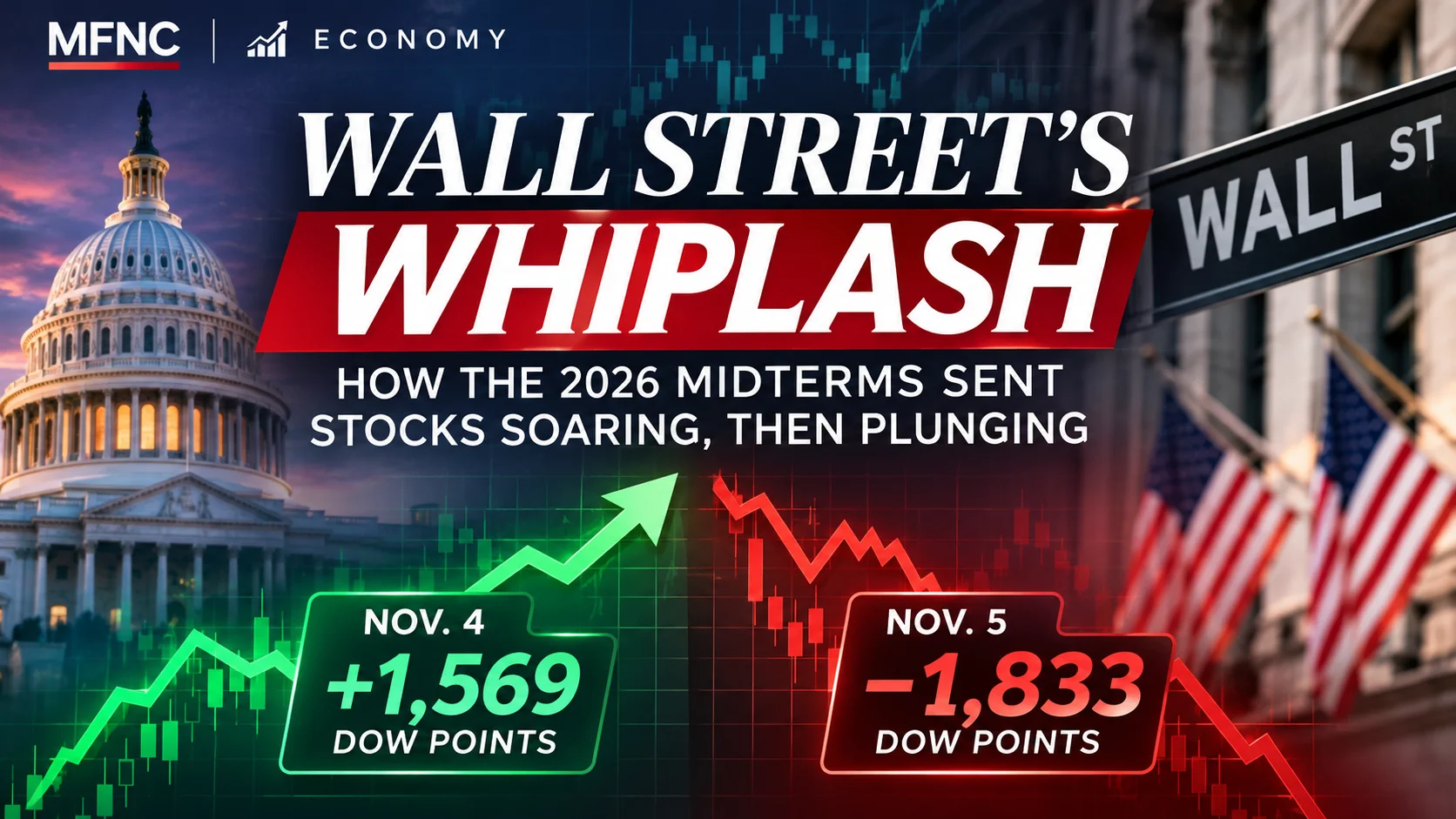
Democrats' sweeping congressional victories initially sent stocks sharply higher. Within 24 hours, concerns about artificial intelligence regulation and economic uncertainty erased the rally, leaving investors facing one of the market's most volatile weeks in recent memory.
NEW YORK — The stock market's first reaction to the 2026 midterm elections appeared decisive.
On Wednesday, November 4, investors sent major U.S. stock indexes sharply higher after Democrats won control of both chambers of Congress, ending Republicans' unified control of Washington.
The Dow Jones Industrial Average jumped more than 1,500 points. The S&P 500 gained 1.6%. The technology-heavy Nasdaq Composite advanced 1.4%.
For a day, Wall Street appeared to welcome the election results.
Then came Thursday.
On November 5, the Dow plunged more than 1,800 points, the S&P 500 suffered its steepest decline since April 2025, and the Nasdaq fell 5.5%, entering correction territory.
In just two trading sessions, the market had delivered two sharply contrasting verdicts on the political and economic landscape.
The reversal raised an important question: Why would the same election results appear to reassure investors one day and alarm them the next?
The answer lies in the competing forces driving financial markets—political uncertainty, expectations about federal policy, oil prices, and growing concern over the future of the artificial intelligence industry.
Two days that shook Wall Street
Wall Street's Two-Day Market Reversal
Daily percentage changes across four major U.S. stock indexes, November 4–5, 2026
Dow Jones
S&P 500
Nasdaq
Russell 2000
Hover over a bar to view its exact value.
Daily percentage changes are rounded. Positive values indicate gains; negative values indicate losses. Figures are presented for comparison and may differ slightly from published closing values due to rounding.
The contrast was extraordinary.
Index | Wednesday, Nov. 4 | Thursday, Nov. 5 |
|---|---|---|
Dow Jones | +1,569 points | -1,833 points |
S&P 500 | +1.6% | -4.4% |
Nasdaq | +1.4% | -5.5% |
Russell 2000 | +1.6% | -4.4% |
By Thursday's close, the S&P 500 stood at 7,353.73, below its election-day close. The Nasdaq finished at approximately 24,315, while the Dow ended at 51,523.06.
Reuters reported that the selloff wiped approximately $2.5 trillion from the market value of companies in the Nasdaq 100, highlighting the scale of losses among major technology stocks.
But those numbers do not mean the entire American economy lost $2.5 trillion in productive capacity overnight. Stock market capitalization measures what investors are willing to pay for publicly traded companies, not the total output of the economy.
Why investors initially celebrated the election results
Wednesday's rally reflected several developments occurring simultaneously.
Democrats had won control of the House of Representatives and Senate, creating the prospect of divided government during the remaining years of President Donald Trump's second term.
For some investors, that meant fewer opportunities for sweeping changes to tax, spending, and regulatory policy.
Markets often react positively when uncertainty decreases, even if investors do not necessarily favor the political party that won.
Reuters reported that investors also responded to falling oil prices, a weaker dollar, and declining Treasury yields. Analysts connected some of those movements to expectations that a Democratic Congress could constrain further escalation of the U.S.-Israeli war involving Iran.
That interpretation is important because the rally cannot be attributed to election results alone.
The price of oil, geopolitical developments, corporate earnings, and expectations about interest rates all influence stock valuations.
Wednesday's market gains reflected a combination of those forces.
Why everything changed on Thursday
The next trading session exposed a vulnerability that had been building for months: the market's dependence on artificial intelligence investment.
The AI boom had driven enormous spending on semiconductors, data centers, electricity infrastructure, and computing equipment. Investors had rewarded companies expected to benefit from that expansion.
But the election results introduced questions about how quickly that infrastructure could continue growing.
Following Democratic victories, some investors became concerned that opposition to data-center development could lead to additional restrictions or delays.
Those expectations were especially significant for companies whose future revenue depended on continued rapid construction of AI facilities.
On Thursday, investors began selling technology and semiconductor shares aggressively.
Reuters reported that Nvidia fell more than 9%, while the Philadelphia Semiconductor Index dropped more than 12%. The Nasdaq suffered its largest daily decline in 19 months.
The artificial intelligence problem
The market's reaction illustrates an important distinction between the companies developing artificial intelligence systems and the companies building the infrastructure needed to operate them.
Some large technology companies could potentially benefit from slower infrastructure expansion if reduced spending pressures improve profitability.
Companies supplying equipment, financing, construction, and other services for new facilities face different risks.
A delay in data center development can affect projected sales, investment returns, and borrowing needs.
That does not mean new restrictions were already enacted immediately after the election.
Rather, investors were adjusting stock prices to reflect the possibility of future policy changes.
Financial markets regularly react to anticipated developments long before those developments become law.
Reuters documented this divide as early as Wednesday, when some major technology stocks rose while companies involved in building AI infrastructure declined.
What happened to oil, bonds, and the broader economy?
Although stocks dominated the headlines, other financial markets were reacting to the same political developments.
According to the Associated Press, Brent crude oil fell 8.7% on Wednesday, November 4, to $94.62 per barrel, as investors reassessed the outlook for the war involving Iran.
Lower oil prices can reduce transportation and production costs, potentially easing some inflationary pressures. They can also reflect changing expectations about economic demand and geopolitical risk.
Treasury yields also declined as bond prices strengthened.
For consumers, changes in bond yields can eventually influence mortgage rates, business borrowing costs, and other forms of credit, although those relationships are not immediate or guaranteed.
The stock market's decline, meanwhile, should not be confused with a confirmed economic recession.
Stock prices represent expectations about future earnings and financial conditions. They can fall dramatically without an immediate equivalent decline in employment, wages, or economic output.
What does this mean for everyday investors?
For Americans with retirement accounts, brokerage investments, or college savings invested in stock funds, the selloff may have reduced account balances.
The impact depends heavily on what those accounts hold.
A portfolio concentrated in technology companies would generally have experienced different results from one spread across multiple industries and asset classes.
Investors holding broad-market index funds were exposed to the overall decline, while those with substantial semiconductor exposure faced particularly severe losses.
Consider a hypothetical $10,000 investment that exactly tracked the S&P 500, excluding fees and tracking differences.
What $10,000 Would Have Been Worth After Two Trading Days
Hypothetical investment tracking the S&P 500, November 3–5, 2026
Baseline
$10,000
Nov. 4
$10,158
Nov. 5
$9,716
Illustrative calculation based on the S&P 500's November 3 closing value of 7,568.92 and subsequent closing values. Assumes an investment tracking the index, excluding fees, dividends, and tracking differences. This is hypothetical performance, not an actual investment account.
The example demonstrates how quickly a short-lived rally can reverse.
It also illustrates why short-term market movements are an unreliable basis for predicting long-term investment returns.
A two-day decline does not establish where the market will trade in six months or a year.
Does the stock market historically perform better under Democrats or Republicans?
Stock performance depends on factors that extend beyond the party controlling Congress or the White House, including Federal Reserve decisions, corporate profitability, inflation, productivity, wars, and global economic conditions.
Markets also respond to what investors expected before an election.
If an outcome was widely anticipated, much of its potential impact may already be reflected in prices before votes are counted.
The 2026 midterms illustrate that complexity.
Investors initially welcomed the prospect of divided government, then reassessed the implications of potential restrictions on an industry that had helped power the market's advance.
Both reactions occurred in response to the same election, but they emphasized different consequences.
What Wall Street will watch next
Several developments could determine whether the market stabilizes or experiences additional volatility.
The first is the direction of federal policy toward artificial intelligence and data center construction.
The second is the trajectory of oil prices and the conflict involving Iran.
Investors will also watch corporate earnings, inflation, Federal Reserve policy, and negotiations between the incoming Democratic Congress and the Trump administration.
These developments could reinforce or reverse the market's initial interpretation of the election.
It is too early to conclude that the midterm results have permanently changed the direction of the stock market.
What is clear is that investors are reassessing the assumptions underlying some of the market's most valuable companies.
A political victory, an economic uncertainty
The 2026 midterm elections reshaped the balance of political power in Washington.
For financial markets, however, the immediate consequences were anything but straightforward.
On Wednesday, investors appeared relieved by the prospect of divided government and a less uncertain political environment.
On Thursday, concerns about artificial intelligence regulation and the future of infrastructure investment helped produce a historic selloff.
The two sessions demonstrated that Wall Street does not deliver a single, permanent verdict on an election.
Markets respond to competing expectations, new information, and changing assessments of risk.
And sometimes, those assessments can change dramatically in less than 24 hours.
The longer-term consequences of the 2026 elections for investors remain uncertain.
For now, the clearest lesson is that political change can reshape market expectations far more quickly than it reshapes the underlying economy.