A historic election for state leadership
The November 3, 2026, midterm elections did more than determine which political party would control state governments. In states across the country, voters elected governors who broke longstanding barriers involving race, gender, ethnicity, and political representation.
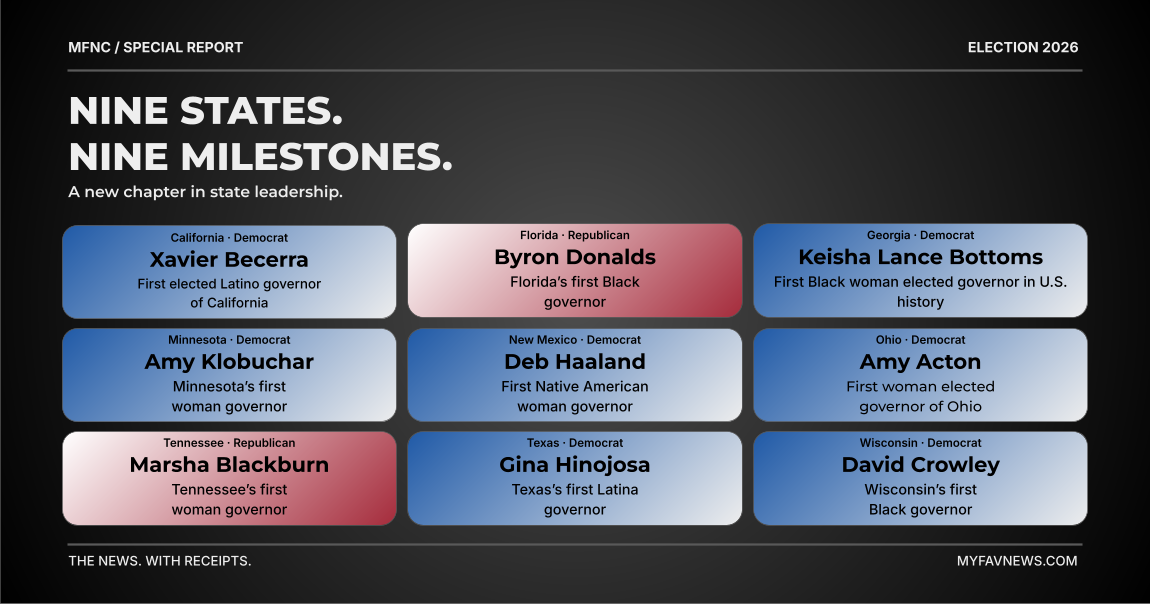
Among the most consequential milestones were the election of the first Black woman to govern a U.S. state, the first Native American woman elected governor, and the first Black governors elected in Florida and Wisconsin.
Other states elected their first women governors, while California and Texas reached new milestones in Latino political representation. Several elections also ended lengthy periods of control by one political party.
These victories occurred in different political environments. Some were won by Democrats, others by Republicans. Some candidates defeated incumbents, while others succeeded governors who could not or chose not to run again.
Together, the nine races examined here illustrate an important distinction: the historical significance of an election is not determined solely by which party wins.
This article examines nine governors-elect featured in MFNC's political directory. It is not an exhaustive account of every historic gubernatorial result in 2026.
The nine governors-elect
Georgia
Keisha Lance BottomsNew Mexico
Deb HaalandCalifornia
Xavier BecerraTexas
Gina HinojosaFlorida
Byron DonaldsWisconsin
David CrowleyTennessee
Marsha BlackburnMinnesota
Amy KlobucharOhio
Amy ActonA national first in Georgia
Keisha Lance Bottoms: The first Black woman elected governor in American history
In Georgia, Democrat Keisha Lance Bottoms defeated Republican Rick Jackson to become the first Black woman elected governor of any U.S. state.
The victory was significant beyond Georgia. Despite decades of progress in representation across Congress, state legislatures, and municipal government, no Black woman had previously won a U.S. gubernatorial election.
Bottoms entered the race with executive experience from serving as Atlanta's mayor between 2018 and 2022. She later worked in the Biden administration.
Her victory also returned Georgia's governorship to the Democratic Party for the first time since the 1998 election. Democrat Roy Barnes was the last member of the party elected governor before her.
The election therefore marked two separate developments: a national milestone in representation and a change in Georgia's partisan leadership.
Those developments should not be confused with the policies Bottoms will ultimately implement. Her administration's legislative achievements will depend partly on the composition of Georgia's legislature, budget negotiations, and state law.
Explore Keisha Lance Bottoms's complete profile for her career, policy positions, and election history.
New Mexico elects the nation's first Native American woman governor
Deb Haaland: Another historic first in a career of firsts
Democrat Deb Haaland defeated Republican Gregg Hull in New Mexico, becoming the first Native American woman elected governor of a U.S. state.
A member of Laguna Pueblo, Haaland had already established a series of political milestones before the 2026 election.
In 2018, she became one of the first Native American women elected to the U.S. House of Representatives.
In 2021, she became the first Native American person to serve as a U.S. Cabinet secretary when she took office as secretary of the interior.
The Interior Department oversees major federal responsibilities involving public lands, natural resources, and relationships with tribal nations.
Her election to lead New Mexico represents a different kind of responsibility: governing an entire state, negotiating with its legislature, administering public programs, and setting statewide policy priorities.
Haaland's victory is particularly notable because Native American communities have historically faced barriers to political participation and representation.
The election itself does not resolve longstanding disputes over tribal sovereignty, natural resources, education, or healthcare. Those issues remain subjects of policy decisions and government-to-government relationships.
Read Deb Haaland's full profile for her congressional, Cabinet, and gubernatorial record.
Latino representation reaches new milestones in California and Texas
California and Texas are two of the nation's most populous states, with large Latino populations and substantial influence over national economic and political life.
In 2026, both elected governors whose victories represented major milestones in Latino political representation.
Xavier Becerra: California's first elected Latino governor
Democrat Xavier Becerra defeated Republican Steve Hilton in the race to succeed outgoing Governor Gavin Newsom.
Becerra will become California's first elected Latino governor. The word "elected" is important: California had Latino governors during earlier periods of its history, before modern statehood and electoral arrangements.
His victory marks a milestone in the state's modern elected governorship, rather than the first time a person of Latino heritage has ever governed California.
Becerra previously served in the U.S. House of Representatives, as California attorney general, and as U.S. secretary of health and human services.
That background brings federal and statewide executive experience to an office responsible for one of the world's largest state economies.
His administration will face policy debates involving housing costs, healthcare, energy, immigration, and California's budget.
Explore Xavier Becerra's profile.
Gina Hinojosa: Texas's first Latina governor
In Texas, Democrat Gina Hinojosa defeated Republican incumbent Greg Abbott, becoming the state's first Latina governor-elect.
Hinojosa's victory also ended a long Democratic losing streak in Texas gubernatorial elections.
The last Democrat elected governor before Hinojosa was Ann Richards, who won in 1990 and served from 1991 to 1995.
Hinojosa entered statewide politics after serving in the Texas House of Representatives and previously on the Austin Independent School District Board of Trustees.
Her campaign emphasized public education, affordability, and government accountability.
Defeating an incumbent governor made the Texas result especially consequential for party control. It also demonstrated that the statewide electorate could produce an outcome different from the state's recent gubernatorial history.
That result alone does not establish how Texas voters will behave in future elections. Electoral coalitions, turnout, candidates, and political conditions can change between cycles.
Florida and Wisconsin elect their first Black governors
Two additional states elected their first Black governors in 2026. The candidates came from opposing political parties, underscoring that milestones in representation are not confined to one party.
Byron Donalds: A Republican first in Florida
Republican Byron Donalds defeated Democrat David Jolly to become Florida's first Black governor-elect.
Donalds had served in the Florida Legislature and the U.S. House of Representatives before seeking the governorship.
His campaign received the backing of President Donald Trump and emphasized affordability alongside continuity with the conservative policy direction of outgoing Republican Governor Ron DeSantis.
Unlike several other races examined here, Donalds's victory did not change which party controlled the governor's office.
Instead, it marked a historic change in who would occupy that office while maintaining Republican leadership.
Explore Byron Donalds's full profile.
David Crowley: Wisconsin's first Black governor
Democrat David Crowley defeated Republican U.S. Representative Tom Tiffany in Wisconsin.
Crowley became the first Black person elected governor of the state.
His background differed from Donalds's. Crowley served in the Wisconsin State Assembly before becoming Milwaukee County Executive in 2020.
As county executive, he oversaw public services, local government finances, and administrative operations in Wisconsin's most populous county.
His gubernatorial campaign highlighted affordability, healthcare, education, and his experience negotiating with political opponents.
Crowley's victory maintained Democratic control of Wisconsin's governorship following Tony Evers, rather than flipping the office from Republican control.
The Florida and Wisconsin results therefore produced similar historical milestones but different partisan outcomes and policy agendas.
Three states break barriers for women governors
Tennessee, Minnesota, and Ohio also reached important milestones involving women elected to statewide executive leadership.
Their victories occurred across party lines and involved candidates with different professional backgrounds.
Marsha Blackburn: Tennessee's first woman elected governor
Republican U.S. Senator Marsha Blackburn defeated Democrat Jerri Green and independent candidates to become Tennessee's first woman elected governor.
Blackburn entered the race with decades of political experience, including service in the Tennessee Senate, U.S. House, and U.S. Senate.
Her campaign focused on immigration enforcement, national security concerns, government spending, and conservative state policy.
Blackburn's victory continued Republican control of the Tennessee governorship while marking a change in the office's gender representation.
Explore Marsha Blackburn's full profile.
Amy Klobuchar: Minnesota's first woman governor
Democratic U.S. Senator Amy Klobuchar defeated Republican Lisa Demuth to become Minnesota's first woman governor-elect.
Klobuchar previously served as Hennepin County attorney before winning election to the U.S. Senate in 2006.
Her move from the Senate to the governor's office represents a transition from federal lawmaking to state executive leadership.
Although both major-party candidates were women, the outcome was historically significant because Minnesota had never elected a woman to its governorship.
Klobuchar's election continued Democratic leadership of the office.
Read Amy Klobuchar's full profile.
Amy Acton: Ohio's first woman elected governor
Democrat Amy Acton defeated Republican Vivek Ramaswamy in Ohio, becoming the first woman elected governor of the state.
Acton is also set to become Ohio's first Jewish governor.
A physician and former director of the Ohio Department of Health, Acton became widely known for her public health leadership during the COVID-19 pandemic.
Her election ended a lengthy period of Republican gubernatorial control. The last Democrat to hold the office was Ted Strickland, whose term ended in 2011.
A historical distinction is necessary here: Acton is Ohio's first woman electedgovernor, not the first woman ever to serve in the office.
Republican Nancy Hollister served briefly as governor from December 1998 to January 1999 after Governor George Voinovich resigned to enter the U.S. Senate.
Acton's election therefore represents the first time Ohio voters selected a woman for the governorship through a statewide gubernatorial election.
What changed politically?
These nine elections did not produce a single uniform political outcome.
Democrats won seven of the nine governorships examined here, while Republicans won two.
Georgia, Ohio, and Texas elected Democrats after extended periods of Republican control.
Florida and Tennessee continued Republican gubernatorial leadership, while California, Minnesota, New Mexico, and Wisconsin continued Democratic leadership.
This distinction matters because a historic first and a partisan change are separate events. An election can accomplish one, both, or neither.
For voters, the practical consequences will depend on how each incoming governor uses the powers of the office and interacts with the state legislature.
Representation and governing are not the same thing
These elections expanded representation in some of the country's most visible state offices. But representation alone cannot establish whether a governor's policies will benefit a particular community or the state as a whole.
Governors have substantial authority over executive agencies, state budgets, emergency management, and appointments. Their precise powers differ by state.
Most also work within systems of divided authority involving legislatures, courts, independently elected officials, and federal law.
A governor's ability to enact campaign proposals may depend on legislative approval, available funding, constitutional limits, and administrative capacity.
That is why evaluating these incoming administrations requires attention to both their historic significance and their actual governing records.
What happens between election night and inauguration?
Although major news organizations have called these races, election-night results are not the same as certified results.
State and local election officials continue processing ballots, canvassing returns, and completing certification procedures under applicable law.
A news organization's race call is an assessment that a candidate has won based on available evidence. It is not an official certification.
Governors-elect also prepare to assume office by organizing transition teams, reviewing agency operations, considering appointments, and preparing legislative priorities.
Inauguration dates and transition procedures differ among states. Most of the governors discussed here are expected to take office in January 2027.
The larger story of the 2026 midterms
The gubernatorial milestones occurred during an election that also reshaped the national political landscape.
Democrats gained control of Congress, while several gubernatorial elections produced changes in party leadership.
But the history made on November 3 was not limited to partisan control.
It included previously unrepresented communities reaching state executive leadership and states electing women to their highest offices for the first time.
The nine governors-elect examined here offer one way to understand those changes. Other historic results occurred in additional gubernatorial and congressional contests.
The lasting significance of these elections will have two dimensions: the historical records established by voters in 2026, and the governing records the incoming administrations build afterward.
Explore the full election coverage
MFNC maintains individual profiles for all nine governors-elect, including their political careers, policy positions, election histories, and source material.
Visit the MFNC Politics hub to explore those profiles and additional election reporting.
For broader coverage of the election's historic firsts, see reporting from NPR and the Associated Press.